


The integrated business planning (IBP) software market is undergoing a fundamental shift. As supply chains grow more volatile — shaped by geopolitical disruption, tariff volatility, and accelerating AI capabilities — enterprises are reconsidering which platform best positions them for adaptive, data-driven planning. Three vendors dominate this conversation in 2026: SAP IBP, o9 Solutions’ Digital Brain, and Kinaxis Maestro. Each targets the same strategic outcome — transforming disconnected planning into a unified, intelligent decision engine — yet they differ sharply in architecture, AI philosophy, integration model, and ideal customer profile.

Why This Comparison Matters
The supply chain planning software market is projected to reach $32 billion by 2026. Enterprises that locked into legacy planning tools or chose a platform three to five years ago are now re-evaluating their choices as AI-powered features move from marketing promise to production capability.
Three developments make this comparison especially urgent in 2026:
SAP ECC end-of-mainstream maintenance arrives in December 2027, forcing migrations that naturally raise the question of whether to consolidate on SAP IBP or diversify.
o9 Solutions filed a legal complaint in November 2025 alleging that three former executives took confidential IP to SAP, sharpening the competitive narrative around AI planning capability.
Kinaxis launched Maestro with generative AI and ML enhancements in late 2024/early 2025, reporting up to 40% reduction in routine manual work and maintaining gross customer retention above 95%.
SAP IBP — The ERP-Centric Planning Platform
SAP Integrated Business Planning for Supply Chain is SAP’s cloud-based planning solution built on SAP HANA and tightly integrated with S/4HANA Cloud. It covers demand planning, supply response planning, inventory optimization, sales and operations planning (S&OP;), and demand-driven replenishment (DDMRP).
Core Architecture & Recent Evolution
The 2025–2026 release cycle represents a major leap for SAP IBP. A harmonized planning area now supports both time-series and order-based planning simultaneously, enabling what SAP calls ‘telescopic planning’ the ability to move fluidly between strategic, tactical, and operational horizons without switching platforms. New AI capabilities currently reaching general availability in Q2 2026 are embedded directly through Joule, SAP’s AI copilot, which provides a natural language interface for planners.
Key AI Capabilities
- Joule AI assistant for natural language queries, health checks, and planning run analysis
- Machine learning forecasting and master data anomaly detection
- Document Grounding planners can search their own SharePoint documents from within Joule in IBP
- AI supply optimizer: explains missed demand fulfillment, inventory targets, and manual adjustments
- Embedded scenario simulations showing risk and alert impacts across all planning horizons
Strategic Positioning
SAP IBP’s defining advantage is its native integration with SAP’s broader ecosystem: S/4HANA Cloud, SAP Business Network, SAP Ariba, SAP Transportation Management, and SAP Analytics Cloud. For enterprises already running SAP as their ERP backbone, IBP eliminates the integration overhead that competitors must bridge with connectors and APIs. The platform’s planning evolution in 2026 aligns with SAP’s broader Autonomous Enterprise vision, where Joule Agents automate time-consuming supply chain tasks end-to-end.
o9 Digital Brain
o9 Solutions, founded in 2009 by Chakri Gottemukkala and Sanjiv Sidhu in Dallas, has built its platform from the ground up as an AI decision engine. With $150 million in annual recurring revenue, $300 million in backing from Generation Investment Management and General Atlantic, and over 130 go-lives completed in 2025 alone, o9 is a formidable challenger to incumbent vendors.
Core Architecture: The Enterprise Knowledge Graph
o9’s defining architectural difference is its Enterprise Knowledge Graph (EKG) — a patented technology that connects internal and external data, captures business relationships, and converts raw data into contextual, decision-grade knowledge. Rather than treating planning as a data pipeline problem, o9 models the business as a living graph of interconnected entities, enabling cross-functional analysis that traditional relational-database planning tools cannot easily replicate.
In March 2026, o9 launched APEX — its next-generation model powered by Neuro-Symbolic AI, which combines the strength of Large Language Models (Neural AI) with the original Enterprise Knowledge Graph (Symbolic AI). The result is a platform that can learn systematically from post-game analysis, deploy new capabilities quickly, and move enterprises from periodic planning cycles toward continuously adaptive decision-making.
Key Capabilities
- Demand forecasting with more than 200 external variables (weather, macro indicators, social signals)
- Advanced demand sensing and supply chain network optimization
- Scenario simulation and what-if analysis across demand, supply, revenue, and financial planning
- Specialized AI agents combining generative and agentic AI with EKG for real-time cross-functional insights
- Self-learning models and self-service no-code/low-code tooling for business users
- Post-game analysis: identifies gaps between plans and execution, uncovering value leakage
- Coverage across 30+ industry verticals
Strategic Positioning
o9 is best understood as an integrated business planning layer above systems of record — it does not replace ERP; it sits on top of it. This positioning is both its strength (vendor-agnostic, works alongside SAP, Oracle, or any ERP) and its challenge (requires disciplined data integration to realize its full potential). For enterprises whose ERP landscape is fragmented or multi-vendor, o9’s approach is strategically attractive. The platform’s breadth — spanning supply chain, commercial, and P&L; planning domains — makes it one of the most comprehensive IBP solutions available.
Kinaxis Maestro
Kinaxis, a Canadian company founded in 1984 and publicly listed on the TSX, built its reputation on RapidResponse — a platform engineered for speed and scenario recalculation at scale. Maestro, launched in late 2024/early 2025, extends this foundation with generative AI and ML capabilities, repositioning the company from a planning specialist toward a broader supply chain orchestration platform.
Core Architecture: Patented Concurrency
Kinaxis’ most defensible technical differentiator is its patented concurrent planning engine backed by an in-memory database. Where most supply chain platforms recalculate plans in batches, Kinaxis recalculates end-to-end supply chain impacts in sub-seconds whenever a data point changes.
Key Capabilities
- Sub-second scenario recalculation via patented concurrent planning engine
- End-to-end supply network visibility from suppliers to distribution centres to customer demand
- Demand.AI with ML-based forecasting for manufacturing and retail
- Maestro Agent Studio: no-code AI agents for planning automation
- What-if scenario simulation across all planning dimensions simultaneously
- Tariff Response tool for rapid trade policy scenario modeling (highly relevant in 2026)
- S&OP;, IBP, demand, supply, inventory, production, and logistics planning in a single platform
- High customer retention: gross retention consistently above 95%
Strategic Positioning
Kinaxis is best suited for organizations managing complex, volatile supply chains where rapid recalculation and scenario agility are mission-critical — automotive, aerospace, high-tech electronics, pharmaceuticals. Its breadth has expanded through acquisitions (Rubikloud, Prana, MPO), extending from planning toward execution-adjacent capabilities. The platform’s AI vocabulary has grown significantly with Maestro, though some analysts note that the AI narrative is still catching up to the underlying technical documentation.
Head-to-Head Comparison
| Dimension | SAP IBP | o9 Digital Brain | Kinaxis Maestro |
|---|---|---|---|
| Core Philosophy | ERP-centric, integrated execution within SAP ecosystem | AI-native, knowledge-graph-driven enterprise decision engine |
Concurrency-first, speed-of-recalculation supply chain orchestration |
| AI Architecture | Joule (GenAI copilot) + embedded ML, Neuro-Symbolic via SAP HANA |
Neuro-Symbolic AI (APEX): LLM + Enterprise Knowledge Graph | Maestro AI: GenAI + ML forecasting, Demand.AI, Agent Studio |
| Planning Breadth | Demand, supply, inventory, S&OP;, DDMRP, telescopic planning | Demand, supply, revenue, financial, procurement — 30+ verticals | Demand, supply, inventory, S&OP;, logistics, production, IBP |
| ERP Integration | Native S/4HANA integration; best-in-class for SAP shops | ERP-agnostic; requires connectors to SAP, Oracle, etc. | ERP-agnostic; integrates with major ERP systems via APIs |
| Speed / Recalc | HANA in-memory; strong but not Kinaxis-native concurrency | Real-time via Knowledge Graph; strong for cross-domain analysis |
Patented sub-second concurrent recalculation; fastest in class |
| Scenario Simulation | Embedded scenario simulations across all planning horizons | Advanced what-if with 200+ external variables | Simultaneous multi-dimensional what-if; Tariff Response tool |
| Demand Sensing | Daily/intraday signals: POS, logistics, weather, social, macro | 200+ external variables fused into continuous demand signal | Demand.AI ML forecasting; strong in retail and manufacturing |
| Ease of Implementation | Complex; easier for existing SAP customers | Complex; requires mature data and process discipline | Complex; steep learning curve but strong professional services |
| Best Fit | SAP-centric enterprises; global manufacturers already on S/4HANA | Multi-ERP or non-SAP enterprises; commercial + supply chain alignment | Complex, volatile supply chains in automotive, pharma, high-tech |
Deep-Dive: Key Differentiators
AI Architecture — The Fundamental Split
SAP IBP embeds AI as an enhancement layer on top of a mature ERP execution engine Joule provides natural language access to plans.
o9 inverts this model entirely. The Enterprise Knowledge Graph is the foundation, not a layer on top. Every planning entity — products, customers, suppliers, locations, constraints — exists as a node in a graph that encodes relationships and context. When an AI model runs, it does so on top of semantically rich data, not flat tables. The APEX model’s Neuro-Symbolic AI combines the pattern recognition of LLMs with the structured reasoning of the Knowledge Graph, enabling more reliable, explainable decision-making than pure neural approaches.
Kinaxis takes a third path: its AI story is built on the foundation of concurrency.
The value of Maestro’s AI features (Demand.AI forecasting, Agent Studio, GenAI automation) is amplified by the platform’s ability to instantly recalculate the impact of any AI recommended action across the entire supply network. You cannot fully evaluate the speed of recalculation and the value of AI recommendations separately — in Kinaxis, they are architecturally inseparable.
Where You Start Matters
For enterprises running SAP, IBP is the natural home. The integration overhead that o9 or Kinaxis must absorb through APIconnectors, data pipelines, and master data harmonization is largely handled natively in IBP. S/4HANA master data flows directly; financial and operational plans align through SAP’s unified data model; and the rollout of SAP Business Data Cloud in 2026 strengthens the data foundation further.
For non-SAP or multi-ERP enterprises, o9 and Kinaxis are more agnostic. o9’s Knowledge Graph is explicitly designed to sit above systems of record, ingesting data from any ERP. Kinaxis similarly connects through standard integration layers. However, both vendors require significant up-front data engineering investment — a point consistently flagged in implementation reviews.

Three Different Speeds
Scenario planning capability is arguably where the platforms diverge most visibly in day-to-day use. Kinaxis’ concurrent engine is the market benchmark for speed a planner can change a constraint. For industries managing frequent disruptions (automotive, high-tech, pharma), this is a decisive advantage.
o9 offers advanced scenario simulation enriched by its 200+ external variable demand model. The ability to simulate how a tariff change, a geopolitical event, or a weather pattern affects demand-supply balance — and to see this across financial, commercial, and operational planning simultaneously — is a key strength.
SAP IBP’s harmonized scenario simulations across all planning horizons (introduced in 2025/2026) bring it closer to parity. The new embedded scenario engine shows the impact of risks and alerts on orders across strategic, tactical, and operational levels, which was a noted gap in previous versions.
The Legal Controversy: o9 vs. SAP
No analytical comparison of SAP IBP and o9 in 2026 is complete without addressing the legal dispute.
o9 alleges that these documents helped SAP sharpen its AI-driven planning messaging and accelerate capability development.The case remains active as of May 2026. For enterprises evaluating both platforms, the controversy is worth monitoring: it signals the intensity of AI-driven planning competition and raises questions about the pace and authenticity of SAP IBP’s recent AI feature velocity.
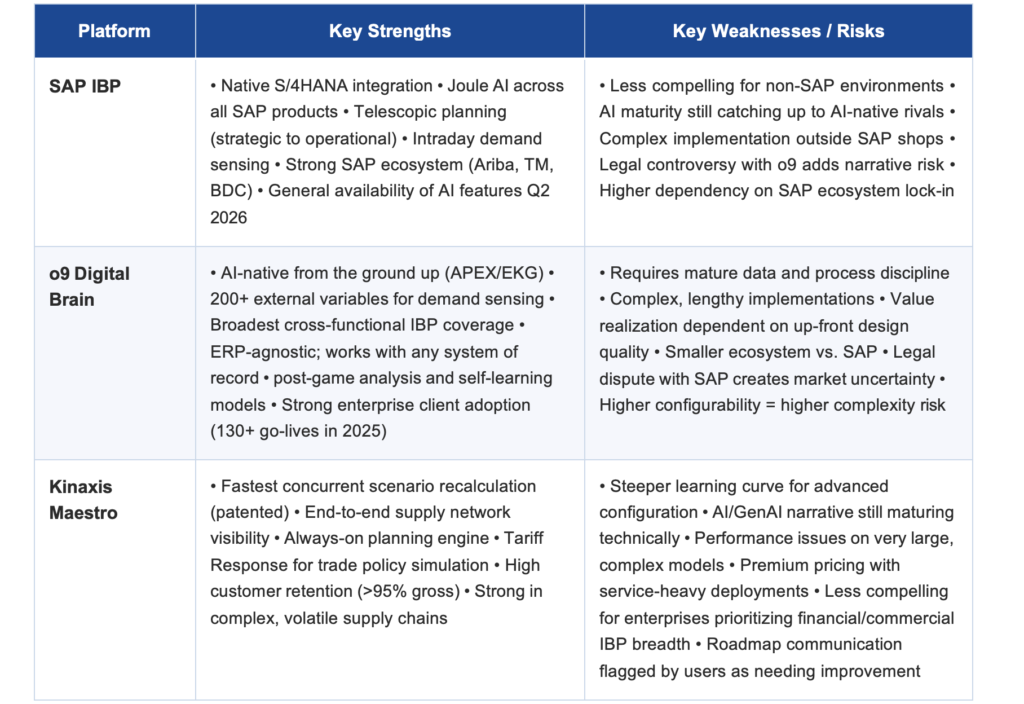
Strengths and Weaknesses Summary
Which Platform for Which Enterprise?
No single platform wins every evaluation. The right choice depends on three primary factors: your existing ERP landscape, your supply chain complexity profile, and your organizational maturity for AI-driven planning. Below is a practical decision framework.
Choose SAP IBP if:
- Your enterprise is deeply committed to the SAP ecosystem (S/4HANA, Ariba, SAP TM)
- You want to minimize integration complexity and leverage native data flows
- You are migrating from SAP APO or SAP SNP and need a proven upgrade path
- You want AI capabilities (Joule) that extend across your entire SAP landscape, not just planning
- You are a global manufacturer or retailer with high planning volume and multi-ERP is not your situation
Choose o9 Digital Brain if:
- You operate across multiple ERP systems (SAP + Oracle, or non-SAP core)
- Your IBP process needs to span supply chain, commercial, and financial planning in one platform
- You want the most AI-native architecture with the deepest demand sensing capabilities
- You are in a 30+ industry vertical and need configurable, scalable planning models
- Your organization has the data maturity and implementation resources to realize o9’s potential
Choose Kinaxis Maestro if:
- Your supply chain is highly complex, volatile, and disruption-prone (automotive, pharma, high-tech, aerospace)
- Speed of scenario recalculation is mission-critical — you need to see supply network impacts instantly
- You need end-to-end visibility from tier-2 suppliers through to customer demand in a single view
- You are dealing with volatile trade conditions and need robust tariff/policy scenario tooling
- Your S&OP; and supply planning processes are your core competitive differentiator

The 2026 IBP platform landscape represents the maturation of supply chain planning from periodic batch processing to always-on, AI-assisted decision intelligence. SAP IBP, o9 Digital Brain, and Kinaxis Maestro are each credible, enterprise-grade choices — but they carry fundamentally different architectural bets. SAP is betting that AI embedded within the ERP execution layer, accessible through a unified copilot (Joule), delivers the most business value for the enterprises it already serves.
For IT consultancies, digital transformation advisors, and supply chain leaders evaluating these platforms in 2026, the recommendation is clear: do not evaluate these platforms on feature lists. Evaluate them on architectural alignment with your integration landscape, the organizational maturity required to realize their full value, and the specific supply chain challenges — speed, breadth, or ecosystem coherence — that matter most to your business.
Do you have any questions about Bolders Consulting Group’s services? Or, are you looking for more information regarding our solution development services? Contact Bolders today to learn how we can help transform your business with our solutions!