


Europe’s regulatory stack has quietly become one of the most consequential shifts in enterprise IT. For SAP-driven organisations, data sovereignty is no longer a compliance checkbox, it’s a boardroom decision.
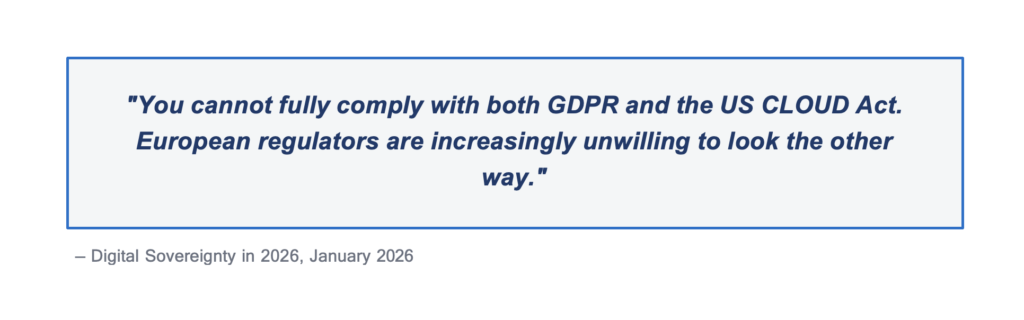
For years, European enterprises accepted a quiet contradiction: GDPR required them to protect EU citizen data, while the US CLOUD Act allowed American authorities to demand access to data held by US-headquartered cloud providers —regardless of where that data physically sat. Many chose to look the other way.
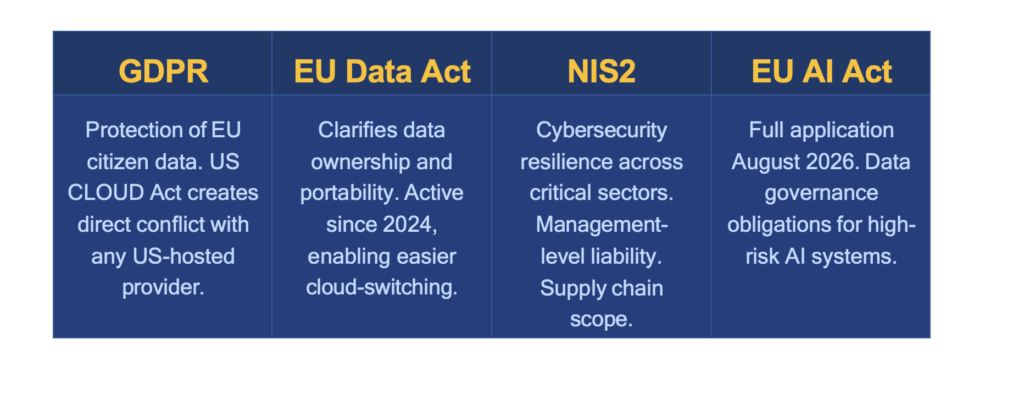
In 2026, looking the other way is no longer an option. Cumulative GDPR fines have surpassed €7.1 billion. NIS2 is in its first real enforcement cycle. The EU AI Act reaches full application in August 2026. And the European Commission isactively pursuing a Tech Sovereignty Package designed to reduce Europe’s dependence on foreign technology providers. The digital borders of Europe are being drawn — and your SAP data sits right at the boundary.
The Regulatory Stack Reshaping Enterprise IT
Four interlocking regulations now create a layered sovereignty architecture that affects almost every SAP-running organisation in Europe:
What SAP Is Doing About It
SAP has moved decisively to meet the sovereignty demand. Key developments in 2026:
EU Access from SAP. SAP’s dedicated service ensures personal data is stored and processed exclusively within the EU and Switzerland even in complex hybrid operating models.
Sovereign Cloud expansion. In February 2026, SAP expanded its EU sovereign-cloud network to Frankfurt andAmsterdam, giving public-sector and regulated-industry buyers in Germany and the Netherlands the option of national-border data hosting.
AWS European Sovereign Cloud + SAP. Launched in January 2026, AWS’s European Sovereign Cloud is physically and logically separate from standard AWS regions, operated exclusively by EU residents, with metadata that never leaves the EU. SAP immediately confirmed support — ending the dilemma for organisations that needed cloud innovation without jurisdictional compromise.
RISE with SAP — Sovereign Edition. SAP is positioning its RISE offering with sovereign deployment options, allowing S/4HANA cloud customers to specify EU-only data residency as a contractual commitment.
Why This Matters for Supply Chain & Logistics
Supply chain data is not abstract. It includes supplier contracts, logistics routes, inventory positions, demand forecasts, and operational performance data — much of it commercially sensitive and increasingly subject to sovereignty requirements in regulated industries like pharmaceuticals, defence, and critical infrastructure.
NIS2’s supply chain scope is particularly significant: organisations are now accountable for the sovereignty posture of their entire supplier network, not just their own systems. For SAP IBP and EWM environments managing extended supply chains, this means understanding where every data flow goes — and being able to prove it to regulators.
And with agentic AI entering supply chain workflows in 2026, the EU AI Act adds another layer: high-risk AI systemsmust maintain full data lineage, audit trails, and human oversight mechanisms. That requires sovereign, auditable infrastructure from the ground up — not a bolt-on compliance layer.
Three Steps to Get Ahead of Sovereignty Risk
- Map your data flows. Know exactly where your SAP data — transactional, analytical, AI-processed is stored, processed, and transferred. This is the foundation of any sovereign compliance posture.
- Review your cloud contracts. Audit your hyperscaler and SaaS agreements for jurisdiction clauses, governmentaccess provisions, and data residency commitments. US CLOUD Act exposure must be explicitly assessed.
- Align your S/4HANA migration with sovereignty requirements. If you are planning an S/4HANA migration, now is the time to build sovereign deployment options into the architecture not retrofit them afterwards. Clean Core and SAP BTP extensions simplify compliance by keeping data logic inside governed, auditable boundaries.
Sovereignty Is a Competitive Advantage
Organisations that get ahead of EU data sovereignty can offer customers and partners something increasingly rare: a provable guarantee that their data stays where it belongs. That is not just a legal position it is a commercial differentiator, particularly in regulated industries and public-sector markets where trust is the product.
The regulatory pressure is not easing. Sovereign cloud spending in Europe is growing 83% year over year. The tools, the infrastructure, and the SAP product suite to support full data sovereignty are all available today. The only question is whether your organisation acts proactively or waits for a regulator to force the issue.