

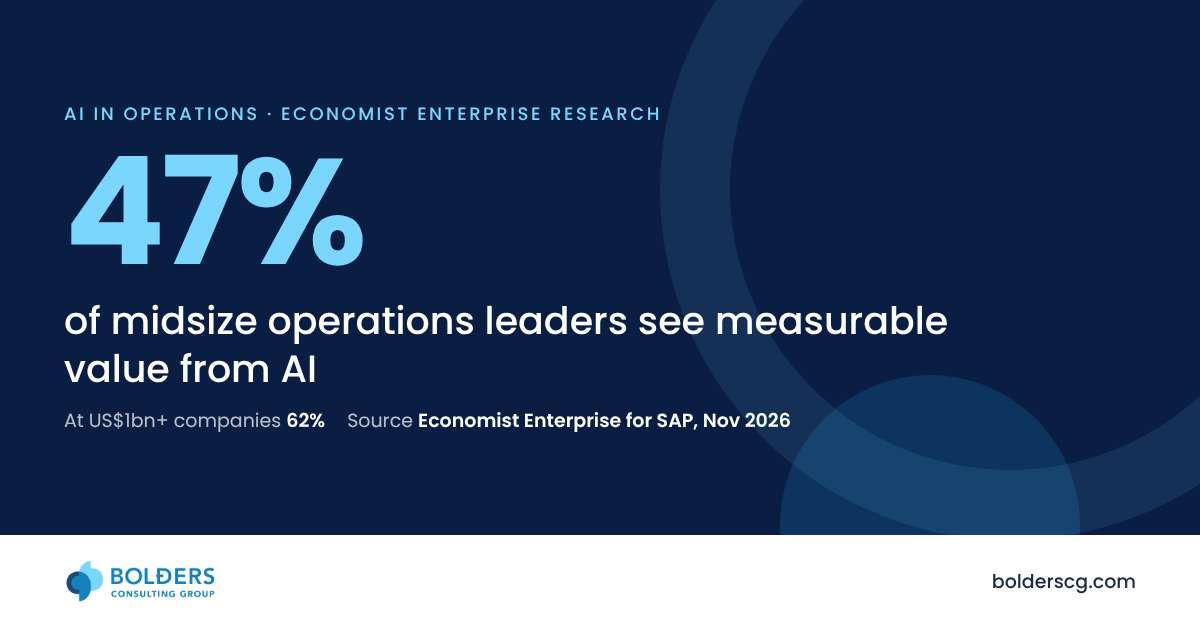
47%. That’s the share of operations leaders at midsize companies who say their AI investments deliver measurable value. At companies with more than US$1 billion in revenue, it’s 62% (SAP News, 6 November 2026).
The numbers come from new research by Economist Enterprise, sponsored by SAP. It surveyed 2,015 C-suite executives at companies with revenues between US$50 million and US$1 billion, across the Americas, Europe and Asia-Pacific.
What the research found
For supply chain and operations, a few findings stand out:
- Operations has more weight than before. Nearly half of executives rank supply chain, procurement and operations among the three most influential functions in their company.
- Disruption is the top worry. 43% of operations leaders name supply chain disruption as a top concern, and 38% operational resilience.
- AI is running ahead of the people. 59% say AI adoption is moving faster than changes to skills and ways of working. Only 4% say the two are advancing together.
The report’s conclusion is plain: the companies getting the most from AI aren’t necessarily spending more. They connect the technology to the processes and the people who use it.
The research also sees an advantage for midsize companies. With flatter structures and shorter lines, they can bring technology, people and processes into line faster than large enterprises. The gap with larger companies is real, but it can be closed.
Why AI projects stall in operations
We see the same pattern in planning and logistics teams. A model or tool gets bought, a pilot runs, and then it stops. Usually for one of three reasons:
- No clear task. “Use AI in planning” is not a task. “Prepare the weekly demand review for each product family” is.
- Data nobody trusts. If planners have to check every number the tool gives them, they stop using it. Clean, shared data has to come first.
- The way of working stays the same. If the meeting, the spreadsheet and the sign-off stay as they were, the AI output becomes one more report to read.
None of these is a technology problem. That’s why buying a better model rarely fixes them.
What works: one task, done well
When we built Ask Lily, our AI agent for demand planning, with Evergreen Garden Care, we started with one recurring piece of research and reporting work. The result was 6.5 days back per demand planner every month, and around forty new AI ideas from other parts of the business once people had seen it work (read the story).
The lesson matches the research. The value came from picking a task people already did every week, using data they already trusted, and changing how the work was done. The model itself was the smaller part.
For a midsize company, that is good news. You don’t need a large AI programme to get started. You need:
- One task that takes real time every week or month.
- Data for that task that is clean enough to rely on.
- A team willing to change how they do it, and someone who owns the result.
- A number to measure before and after: hours saved, forecast error, days to close a review.
Once the first task works, the next ones are easier, because the data and the habits are already in place.
How we can help
Bolders helps companies build trusted, reusable data products and put AI into everyday supply chain work, on cloud platforms they can scale. We start with the process and the data, then the model. See our data and AI services →
Want to see an AI agent working on real planning tasks? Talk to Lily. For more on getting the basics right, see Why Supply Chain AI Needs a Reality Check.