

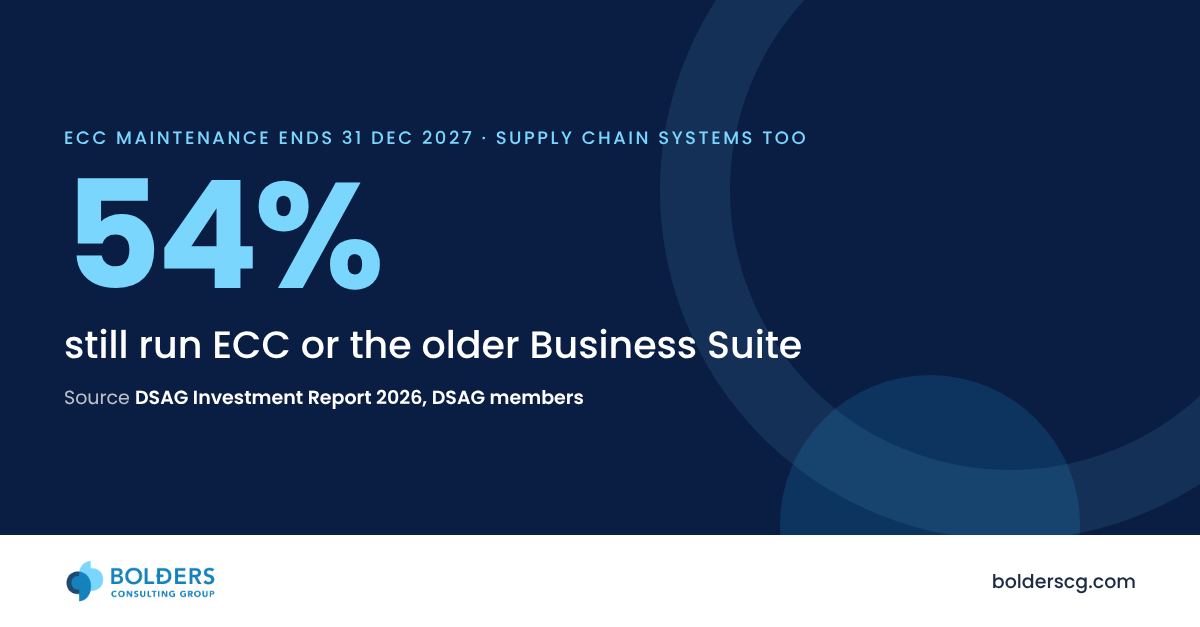
54%. That’s the share of companies in the German-speaking SAP user group DSAG that still run SAP ECC or the older Business Suite, according to its Investment Report 2026. Two years ago it was 68% (DSAG, 26 February 2026).
Mainstream maintenance for ECC ends on 31 December 2027, a little over a year from now. Among DSAG members still investing in ECC, 37% plan to switch to S/4HANA by the end of 2027. Almost half plan to switch by the end of 2030 and pay for extended maintenance in the meantime.
The end of maintenance is weighing on budgets too. 63% of respondents said it influences their SAP investment decisions. DSAG chairman Jens Hungershausen points to the reasons for the delays: skills shortages, parallel projects and limited budgets are pushing schedules back, “even if this results in higher maintenance costs.”
It’s not only the ERP
Most of the discussion is about the ERP system. But many supply chain systems run on the same platform and reach the same date:
- SAP APO. Demand planning, supply network planning and production planning in APO run on SAP Business Suite 7, so mainstream maintenance ends at the end of 2027 as well (2iSolutions). The successors are SAP Integrated Business Planning (IBP) and production planning and detailed scheduling (PP/DS) inside S/4HANA.
- EWM on SCM. SAP says mainstream maintenance for EWM 9.5, the version that runs on the SCM platform, also ends at the end of 2027. The move is to EWM on S/4HANA, embedded or decentralised (SAP Community).
- Classic warehouse management. Companies that kept classic WM inside S/4HANA used it under a compatibility pack. SAP’s own guidance was to move those warehouses to EWM by the end of 2025 (SAP user groups).
So a company that plans “ECC to S/4HANA by 2030” may still have planning and warehouse systems that need attention sooner.
Why the supply chain part is harder
An ERP conversion moves most data and processes across. Planning and warehouse systems are different. IBP is not APO in a new version, and EWM is not classic WM with a new screen. Planning models, warehouse processes and the way people work change with them.
That takes time, and it is also a chance. Teams often keep processes that only made sense because of the old system’s limits. The move is a good moment to ask which of them you still need.
Five questions for the next twelve months
- Which supply chain systems run on Business Suite 7? List APO, EWM, TM and anything else on the SCM platform, with their versions.
- What is the target for each? IBP, embedded PP/DS, embedded or decentralised EWM, or something else. Decide per system, not only for the ERP.
- What is the order? Some companies move planning first, some the ERP. The answer depends on where the risk and the value are.
- Who keeps the current systems running? During a migration, the people who know the old system best are usually needed in the project. Plan for that gap.
- What does extended maintenance cost you? Compare it with the cost of moving the supply chain systems earlier.
How we can help
Bolders implements SAP supply chain execution, including EWM, TM and embedded PP/DS, and supply chain planning with SAP IBP. While a migration runs, our application management services can keep the current systems stable, so your own team can focus on the project. See our supply chain execution services →
For planning, see our supply chain planning services, and our earlier post on choosing a planning tool.