

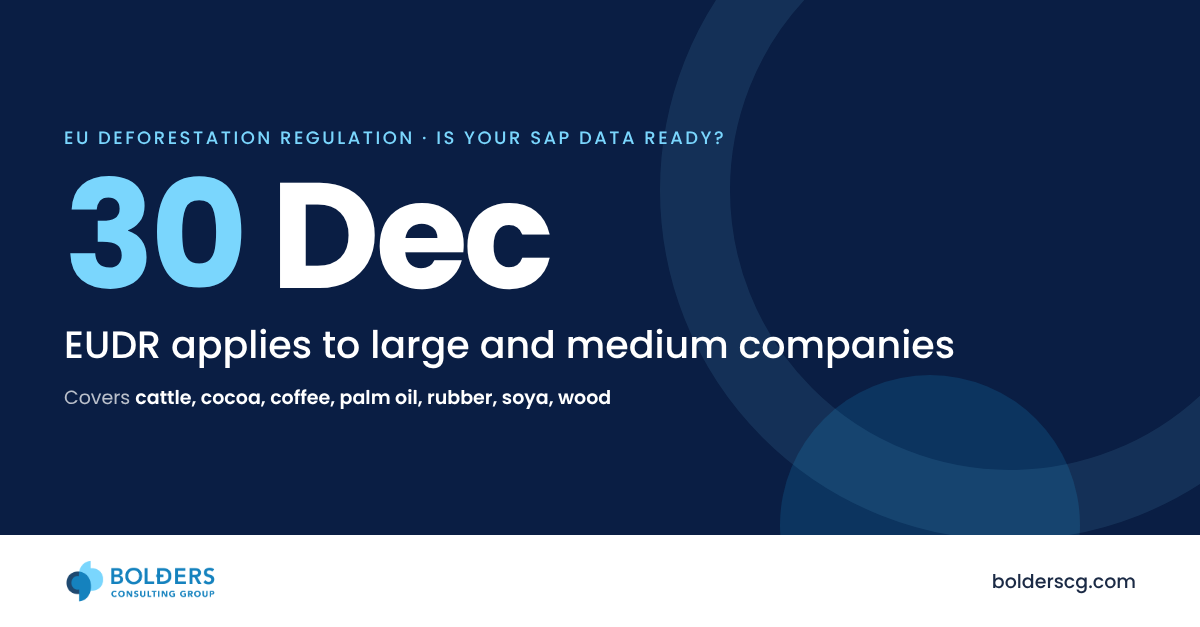
30 December 2026. From that date, the EU Deforestation Regulation (EUDR) applies to large and medium-sized operators and traders, and to downstream operators and traders of every size (European Commission, Access2Markets). At the time of writing, no further postponement has been proposed. That leaves about six weeks.
The regulation covers cattle, cocoa, coffee, palm oil, rubber, soya and wood, and products made from them. Any company that places these products on the EU market, or exports them, has to show they are deforestation-free and legally produced. In practice, that is a data problem as much as a legal one.
What changed with the 2025 amendment
Regulation (EU) 2025/2650 moved the start date and made the rules lighter for companies further down the chain (Stibbe, December 2025):
- Only the first company does full due diligence. The operator that first places a product on the EU market collects the data, assesses the risk and submits a due diligence statement to the EU information system.
- Downstream companies pass on a reference number. A chocolate maker using cocoa that is already covered no longer files its own statement. It must collect and keep the reference number of the original statement.
- Micro and small operators get until 30 June 2027 for most products, and can use a simplified declaration.
So for many companies, the job is now smaller. But it hasn’t gone away. Primary operators still need plot-level geolocation and proof of legality before goods enter the EU. Everyone else needs to receive, store and pass on reference numbers for every relevant delivery, and be able to show them to an authority.
Where SAP comes in
A reference number is only useful if it stays attached to the goods. That means it has to arrive with the purchase order or delivery, be checked at goods receipt, follow the batch through the warehouse and go out again with the sales delivery. In most companies, those steps already run in SAP.
Dunlop Tyre Europe gives a good picture of what that looks like. In its latest update, the company says it has connected SAP to the EU information system (TRACES) and to its logistics and barcode systems, added a validation check at goods receipt, and tested processes, data and interfaces across the whole chain. Until 30 December, it is working on data quality, more automated checks and audit preparation (Dunlop Tyre Europe, 2026).
Note where the work sits: goods receipt, warehousing, shipping and master data. EUDR compliance is built into the supply chain processes, not kept in a separate spreadsheet next to them.
Six weeks: what to check first
- Know your role per product. For each covered product, decide whether you are an operator, a downstream operator or a trader. The role sets what data you need.
- Find the gaps in your supplier data. Which suppliers already send due diligence reference numbers or geolocation data? Which don’t? Start with the volumes that matter most.
- Decide where the reference number lives in SAP. On the batch, on the delivery or both? If it isn’t stored where the goods move, it will get lost between receipt and shipment.
- Put a check at goods receipt. A delivery of a covered product without a valid reference should be stopped or flagged, not found months later in an audit.
- Test one flow end to end. Pick one product, follow it from purchase order to customer delivery and see whether the evidence comes out at the end.
None of this needs a new system on day one. It needs clear ownership and clean master data in the systems you already run.
How we can help
Bolders works on SAP supply chain execution, including warehouse and transport processes, and on data-driven sustainability. Our sustainability team helps companies trace data through their supply chains, and EUDR is where that meets daily logistics. If you’re not sure where you stand, our free sustainability assessment is a quick first step. See our sustainability services →
We wrote earlier about transport emissions from data you already have in SAP and how SAP is putting ESG into daily operations.
This article is general information, not legal advice. Check your obligations with your legal or compliance team.