


Deciding to overhaul your supply chain planning systems is a significant undertaking. It requires substantial capital, time, and organizational buy-in. When looking at SAP IBP, it is easy to get lost in the vendor promises of AI-driven forecasting and seamless integration. But as a business leader, what you really need to know is: What is the actual Return on Investment (ROI), and what does it take to realize it in the real world?
What is SAP IBP?
Unlike traditional, siloed software installations, SAP IBP is a cloud-based, comprehensive supply chain transformation platform powered by SAP HANA. It is designed to unify Demand Planning, Supply Planning, Inventory Optimization, and Sales & Operations Planning (S&OP) into a single source of truth.
However, implementing it is not simply a technical upgrade—it is a fundamental shift in how your business forecasts, plans, and responds to market volatility.
A Platform Built for Today’s Supply Chain
Unlike standalone planning tools, SAP IBP connects directly with your SAP S/4HANA ERP backbone — and increasingly with non-SAP data sources through the SAP Business Technology Platform. This deep integration means planners are always working with accurate, live data rather than batch-processed snapshots that are outdated by the time they are actioned.
The Strategic Shift from Reactive to Predictive
The most significant value driver of SAP IBP is not efficiency — it is the shift from reactive firefighting to predictive, scenario-driven planning. Organisations that move from spreadsheet-based S&OP; to SAP IBP consistently report that their planning teams spend less time gathering and cleaning data, and far more time on value-added analysis and decision support.
Quantifying the ROI
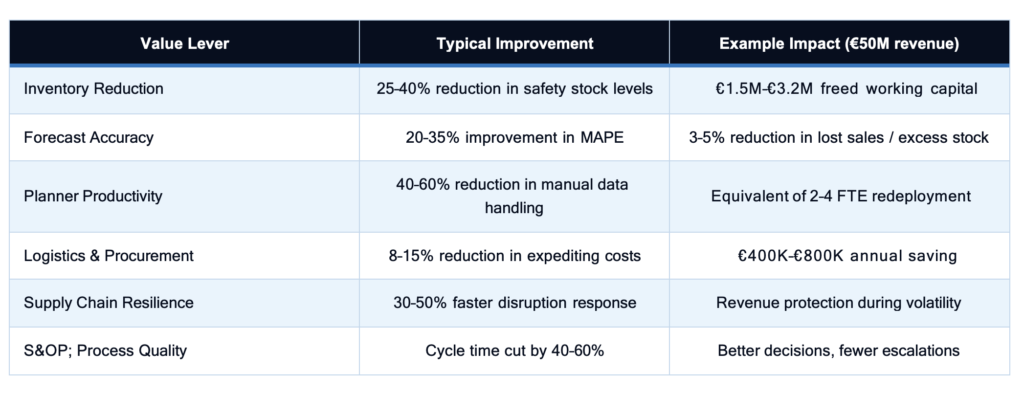
ROI in supply chain technology is most credible when it is decomposed into specific, measurable value levers. Based on our project experience and benchmarking data from SAP and independent research, we identify six primary categories of financial return:
What Drives (and Destroys) SAP IBP ROI
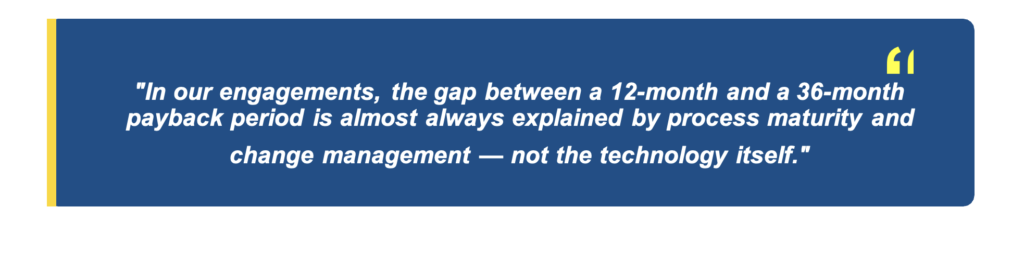
Not all SAP IBP implementations deliver the same results. In our experience, the delta between high-performing and underperforming implementations comes down to a handful of critical factors:
Executive sponsorship with P&L: When ROI ownership sits at C-suite or VP level, projects move faster, data governance gets resolved, and adoption is treated as non-negotiable.
Process redesign before configuration: Organisations that use the IBP implementation as an opportunity to redesign their S&OP; and planning processes — rather than simply replicating existing workflows in a new tool — consistently outperform those that don’t.
Data quality investment upfront: Master data quality is the single biggest technical risk factor. Investing 30–60 days in demand history cleansing, BOM accuracy, and lead-time validation before go-live pays dividends for years.
Phased, value-led deployment: Leading with one or two high-impact modules (typically Demand and S&OP;) and demonstrating early wins builds organisational confidence and funding for subsequent phases.
Integrated change management: Planners who understand why IBP was implemented and how it improves their day-to-day work are dramatically more likely to use it correctly — and to surface the insights that drive business decisions.
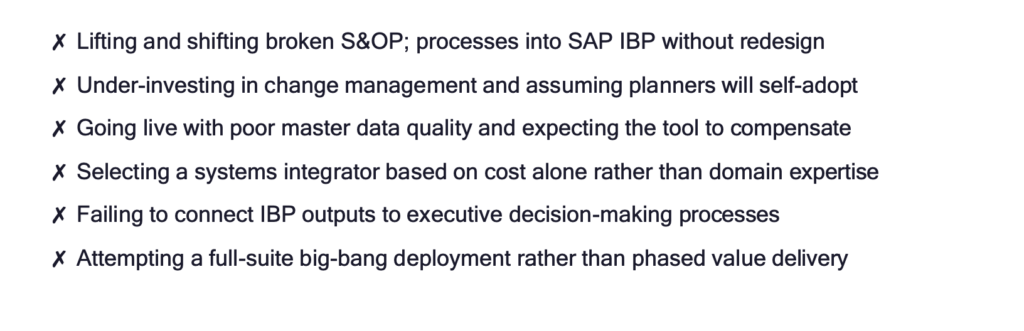
Common ROI Destroyers to Avoid
SAP IBP vs. Competing Platforms
Decision-makers evaluating SAP IBP often compare it to o9 Solutions, Kinaxis RapidResponse, or Blue Yonder. From a pure ROI perspective, the key differentiators are integration depth, ecosystem lock-in, and long-term scalability:
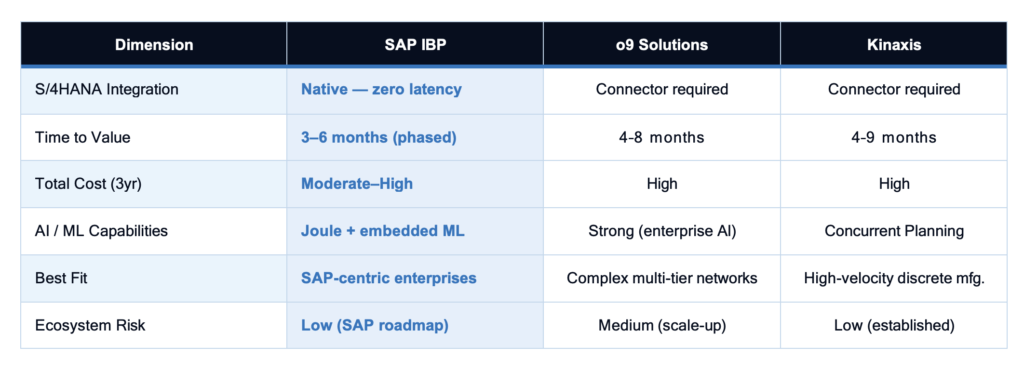
For organisations already running SAP S/4HANA or with a strategic commitment to the SAP ecosystem, IBP delivers the strongest long-term ROI — primarily because integration overhead and data synchronisation costs are dramatically lower than with third-party platforms.
Agentic AI and the Next Wave of IBP Value
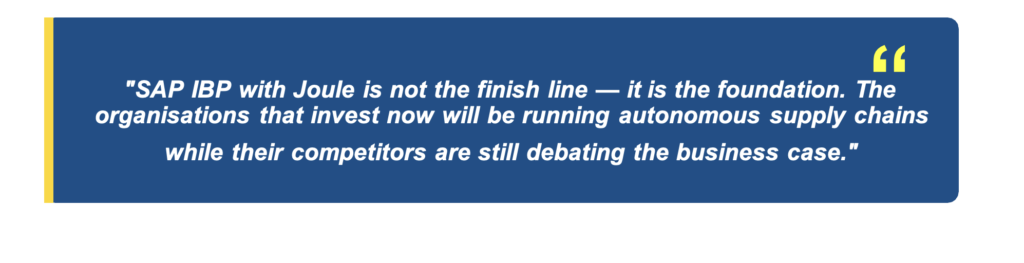
The ROI conversation around SAP IBP is evolving rapidly. With the integration of SAP Joule — SAP’s generative and agentic AI layer — and the broader shift toward autonomous supply chain planning, organisations that implement IBP today are positioning themselves for a step-change in planning productivity over the next 24–36 months.
Autonomous Demand Sensing
Joule-enabled IBP can ingest external signals — news feeds, social sentiment, weather data, macroeconomic indicators — and autonomously adjust demand plans, reducing planner intervention in routine adjustments by up to 70%.
Scenario Co-Pilot
Rather than planners manually building ‘what if’ scenarios, agentic AI can generate, evaluate, and rank supply chain scenarios against defined business objectives — compressing what once took days into minutes.
Supplier Collaboration Automation
IBP’s integration with SAP Ariba and Business Network enables automated supplier capacity checks and replenishment triggers, reducing procurement lead times and the cost of manual coordination.
Continuous Planning Cycles
Traditional monthly or weekly planning cycles are giving way to continuous, always-on planning loops that respond to real-time signals. Organisations that achieve this maturity level report supply chain cost reductions of 20–30% beyond initial IBP ROI.
Building Your Business Case
A credible SAP IBP business case follows a structured five-step process. At Bolders Consulting Group, we use our proprietary BEST Model© framework to ensure that ROI projections are grounded in your actual data — not generic benchmarks.
Step 1: Baseline Assessment: Quantify current-state costs: inventory carrying costs, expediting spend, planner FTE, forecast error impact on service levels and write-offs. This creates the denominator for your ROI calculation.
Step 2: Value Lever Identification: Map your specific pain points to IBP capabilities. Not all levers are equal for all businesses — a process manufacturer’s biggest win may be in S&OP; cycle compression; a distributor’s may be in inventory optimisation.
Step 3: Benefit Quantification: Apply conservative, realistic improvement ranges to your baseline numbers. Use third-quartile benchmarks (not best-in-class) to maintain credibility with CFO audiences.
Step 4: TCO Modelling: Build a 3-year TCO model that includes all cost categories — licence, implementation, internal resource, and ongoing optimisation — to arrive at a net NPV and payback period.
Step 5: Risk-Adjusted ROI: Apply probability weighting to benefit scenarios (conservative / base / optimistic) and present the risk-adjusted case to executive stakeholders. This approach builds credibility and sets realistic expectations.
Do you have any questions about Bolders Consulting Group’s services? Or, are you looking for more information regarding our solution development services? Contact Bolders today to learn how we can help transform your business with our solutions!