


When modern enterprises migrate their operations to the cloud, the physical infrastructure supporting those systems often becomes an afterthought. We speak of the cloud as an abstract, borderless entity. Yet, every byte of enterprise data from financial forecasts to critical supply chain metrics ultimately resides on a physical server rooted in a specific geographic location.
This physical geography is known as data residency, and for modern global businesses, choosing where that data lives is no longer just an IT decision it is a critical strategic imperative.
What Is Data Residency?
Data residency refers to the physical or geographic location where an organization’s data is stored, processed, and managed typically within the borders of a specific country, region, or jurisdiction. Unlike a purely technical concept, data residency carries deep legal, regulatory, and strategic significance for businesses operating in today’s interconnected global economy.
At its core, data residency answers a deceptively simple question: Where, physically, does our data live? This question becomes complex when organizations use cloud infrastructure, SaaS platforms, or distributed systems thatspan multiple geographies. A company headquartered in Germany may store data on servers in Ireland, replicated to the United States, and processed through APIs hosted in Singapore each jurisdiction introducing its own legal and compliance considerations.
Key Insight: Data residency is not just an IT concern — it is a governance, risk, and compliance issue that intersects legal, operations, and executive leadership.
It is important to distinguish data residency from related concepts. While data residency describes where data is stored, data sovereignty describes whose laws govern that data, and data localization refers to legal requirements that mandate data remain within a specific jurisdiction.
Why Data Residency Matters
The growing importance of data residency is driven by four interconnected forces: legal compliance, national sovereignty, cybersecurity, and business trust. Together, these factors make data residency one of the most critical considerations for enterprise IT strategy today.
Regulatory & Legal Compliance
Governments worldwide have enacted laws that dictate how and where data must be stored. Non-compliance can result in severe financial penalties, operational restrictions, or bans on doing business in certain markets. Key drivers include:
- GDPR (EU): Requires that personal data of EU residents be processed lawfully, and restricts transfers outside the European Economic Area without adequate safeguards.
- India DPDP Act (2023): Establishes rules for processing digital personal data within India, with provisions that may restrict cross-border transfers of certain data categories.
- China PIPL & DSL: China’s Personal Information Protection Law and Data Security Law impose strict requirements on data stored within China and cross-border data transfers.
- Russia Federal Law 242-FZ: Requires personal data of Russian citizens to be stored on servers physically located in Russia.
- Brazil LGPD: Brazil’s data protection law closely mirrors GDPR, regulating processing and transfer of Brazilian residents’ personal data.
Data Sovereignty
Data sovereignty refers to the principle that data is subject to the laws and governance of the country in which it is stored or collected. This has real-world consequences: a US court order under the CLOUD Act can compel a US-based cloud provider to hand over data stored in any country, regardless of local privacy laws. Similarly, the UK Investigatory Powers Act grants broad surveillance authority over data processed by UK entities.
For multinational organizations, data sovereignty means that choosing a cloud provider’s nationality is as important as choosing the physical data center location. A German company storing data in a Frankfurt AWS data center is still subject to US law because AWS is a US-incorporated entity.
Security & Jurisdiction
The jurisdiction where data resides determines which enforcement bodies can access it, audit it, or compel itsdisclosure. This affects risk profiles for sensitive workloads such as intellectual property, health records, financial data, and government information. Organizations must consider:
- Which government agencies can request access to the data
- Whether the local legal system offers adequate protection against unauthorized access
- The risk of geopolitical events (sanctions, trade disputes) disrupting access to data hosted abroad
- Whether encryption key management occurs within the target jurisdiction
Customer & Business Trust
Beyond compliance, data residency has become a competitive differentiator. Enterprise customers — particularly in regulated industries like banking, healthcare, and government increasingly require contractual guarantees about where their data is stored. Failure to offer credible data residency commitments can disqualify vendors from procurement processes. Conversely, organizations that clearly communicate their data residency practices build deeper trust with customers and partners.
Data Residency vs. Data Sovereignty vs. Data Localization
These three terms are often used interchangeably but carry distinct meanings. Understanding the differences is essential for accurate compliance planning and client communication.
Data Residency: The Choice of Location
Data residency refers to the physical and geographical location where an organization chooses to store, process, or manage its data. This is typically a business decision rather than a strict legal mandate.
- The “Why”: Companies choose specific data residency locations for operational reasons, such as improving performance by reducing latency (placing servers closer to users), taking advantage of favorable tax environments, or adhering to internal corporate policies.
- Example: A global e-commerce company headquartered in the US might choose to store its European customer data in a data center in Frankfurt, Germany. They do this voluntarily to ensure fast website load times for European shoppers and to reassure those customers that their data is being kept nearby.
Data Sovereignty: The Rule of Law
Data sovereignty is a legal concept. It asserts that digital data is subject to the laws, regulations, and judicial authority of the nation where it is physically collected and stored.
- The “Why”: Sovereignty is about jurisdiction and power. When data crosses a border, it falls under a new set of laws. This can create massive conflicts for multinational companies. For instance, if a government issues a subpoena for data stored within its borders, the hosting company must comply with that local law, regardless of where the data’s owner actually lives.
- Example: If a Canadian company stores its corporate data on servers located in the United States, that data is subject to US laws like the Patriot Act or the CLOUD Act. This means US law enforcement could potentially access that data without consulting the Canadian government.
Data Localization: The Strict Mandate
Data localization is the most restrictive of the three. It is a strict legal requirement passed by a government dictating that data created within its borders must be stored on servers physically located within those borders.
- The “Why”: Governments implement localization laws to protect their citizens’ privacy, ensure national security, and maintain absolute sovereign control over domestic data. Some localization laws dictate that data cannot leave the country at all, while others say a primary copy must remain inside the country, but a duplicate can be transferred internationally.
- Example: Countries like Russia, China, and India have implemented strict data localization laws. For example, India requires that all payment data generated by its citizens be stored exclusively on systems located within India.
Technical Implications for Cloud Architecture
Implementing data residency requirements has significant technical consequences for how cloud infrastructure, SaaS platforms, and application architectures are designed. The following considerations are critical for any enterprise cloud strategy.
Cloud Region Selection
Major cloud providers (AWS, Azure, GCP) offer regional deployments that allow organizations to pin workloads to specific geographic locations. However, region selection alone is not sufficient — organizations must also control where metadata, logs, backups, and caches are stored. Many default platform features (e.g., AI/ML training pipelines, CDN caching, global load balancers) may transfer data outside the designated region unless explicitly restricted.
Encryption & Key Management
For strong data sovereignty, encryption keys must be managed within the target jurisdiction. Customer-managed keys (CMK) or bring-your-own-key (BYOK) arrangements with a locally-hosted Key Management Service (KMS) ensure that even if data is physically accessible to a foreign cloud provider, it cannot be read without local key authorization. This is especially relevant for compliance with Chinese and Russian data laws.
Data Pipeline & ETL Controls
Modern data architectures often move data through multiple systems from operational databases to data lakes, analytics platforms, and third-party integrations. Each hop in the pipeline is a potential residency violation. Organizations must audit and control every data movement, including API calls to SaaS tools, analytics libraries, monitoring agents, and event streaming platforms.
Latency vs. Compliance Trade-offs
Restricting data to a single region can increase latency for globally distributed users and reduce availability in multi-region failover scenarios. Architects must balance these trade-offs using techniques such as data federation (query routing without data movement), regional read replicas, and content delivery networks for non-sensitive static assets.
How to Build a Compliant Data Residency Strategy
Establishing a robust data residency strategy requires a structured, cross-functional approach that aligns legal, technical, and operational stakeholders. Below is a recommended six-step framework.
Step 1: Data Classification & Inventory: Identify all data assets, categorize them by sensitivity (personal, financial, health, IP), and map their current storage locations. Tools such as data catalogs and discovery platforms can automate this process at scale.
Step 2: Regulatory Mapping: For each data category and business geography, identify applicable regulations and their specific residency requirements. Engage legal counsel to assess transfer mechanisms (SCCs, BCRs, adequacy decisions) where cross-border flow is unavoidable.
Step 3: Vendor & Cloud Assessment: Audit all cloud providers, SaaS vendors, and third-party processors for their data residency commitments. Review Data Processing Agreements (DPAs), sub-processor lists, and contractual guarantees. Assess providers’ ability to restrict data to specific regions.
Step 4: Architecture Redesign: Work with engineering teams to redesign data flows that violate residency requirements. This may include regionalizing databases, implementing data masking for cross-border analytics, enforcing region-locked storage policies, and deploying local KMS instances.
Step 5: Monitoring & Enforcement: Implement continuous monitoring to detect residency violations in real-time. Cloud-native tools (AWS Config, Azure Policy, GCP Organization Policies) can enforce guardrails that prevent data from leaving designated regions. Integrate alerts into your SIEM platform.
Step 6: Governance & Review: Establish a Data Residency Committee with representatives from Legal, IT, Security, and Operations. Schedule quarterly reviews to assess regulatory changes, new vendor relationships, and architectural updates. Maintain an auditable trail of compliance decisions.
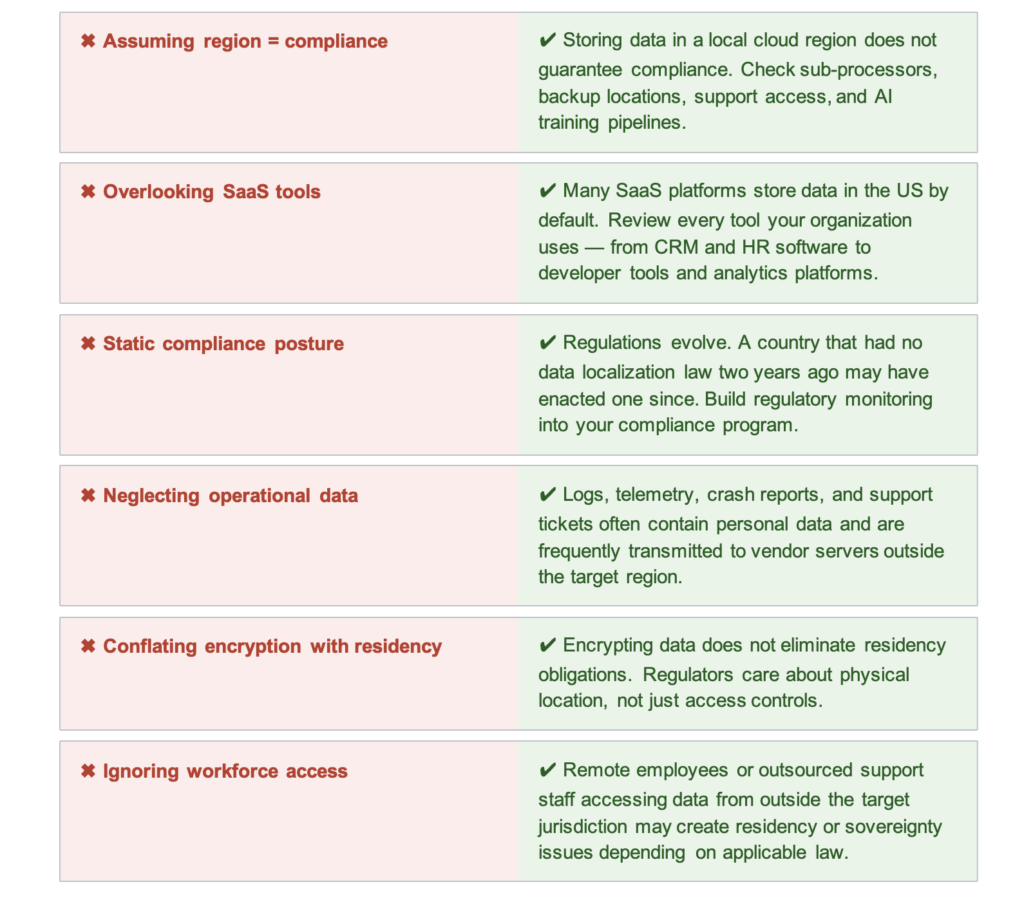
Common Pitfalls & How to Avoid Them
Practical Guidance for IT Consultancies
For IT consultancies advising enterprise clients on digital transformation, cloud migration, or SaaS procurement, data residency is a recurring theme that must be embedded into every engagement not treated as an afterthought. Here is how to make data residency a core part of your advisory practice:
- Include residency in vendor RFPs. When supporting procurement, always include data residency commitments as amandatory evaluation criterion. Request evidence not just claims of regional data isolation.
- Build residency into cloud landing zones. When designing Azure Landing Zones, AWS Control Tower, or GCP Organization structures, enforce region policies by default so business units cannot accidentally violate residency rules.
- Create residency runbooks. Document what your clients must do when adding a new SaaS tool, opening a new market, or changing cloud providers. A short decision tree prevents costly mistakes.
- Advise on transfer mechanisms. When cross-border data transfer is legitimate and necessary, guide clients through the appropriate legal mechanism SCCs for EU transfers, BCRs for intra-group flows, or adequacy decisions where available.
- Stay ahead of regulatory change. Subscribe to updates from data protection authorities (DPAs) in your clients’ keymarkets. Being the first to advise on a new requirement is a high-value differentiator.
The Bottom Line
Data residency has evolved from a niche compliance requirement into a strategic imperative for organizations of every size and sector. As digital operations become increasingly global and regulatory frameworks multiply, the ability to answer the question ‘where is our data?’ with precision and confidence is foundational to trust, compliance, and risk management.
For IT consultancies, data residency represents both a client obligation and a business opportunity. Organizations that can design residency-compliant architectures, navigate multi-jurisdictional regulatory complexity, and help clients make informed vendor choices will be indispensable partners in the digital economy.
The key takeaways from this guide are: understand the distinction between residency, sovereignty, and localization; map your data before your architecture; treat SaaS vendors with the same scrutiny as cloud providers; build monitoring and governance into your residency program from day one; and stay ahead of regulatory change.
Do you have any questions about Bolders Consulting Group’s services? Or, are you looking for more information regarding our solution development services? Contact Bolders today to learn how we can help transform your business with our solutions!