

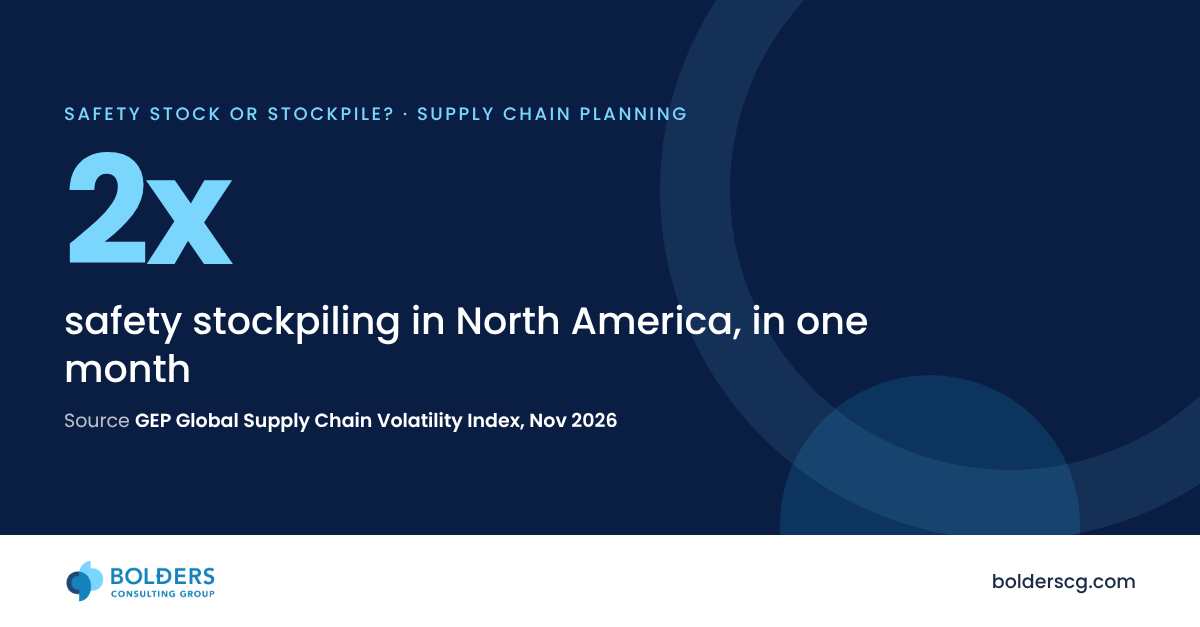
More than double. That’s how much safety stockpiling by North American manufacturers rose in October compared with September, according to the GEP Global Supply Chain Volatility Index. In Europe, inventory building “rebounded sharply”, with Germany as a key driver (GEP, 11 November 2026).
The index is produced by GEP and S&P Global from purchasing manager surveys of around 27,000 companies in more than 40 countries. The message this month is simple: manufacturers are buying ahead because they expect higher prices and more shortages. For planners, that raises a question that sounds easy and isn’t: how much extra stock is enough?
What the index shows
- Stockpiling is historically high. Reports of buying extra stock because of price or supply concerns rose again in October.
- Shortages haven’t gone away. Material shortages were above the long-run average for the eighth month in a row. Oil, electronic and electrical components and metals were most often in short supply.
- Transport is getting dearer. With oil prices rising, the transportation cost index reached a four-month high.
- Europe is busier. The European index rose from 0.66 to 0.78, driven by more purchasing and more inventory.
GEP’s John Piatek also points to the risk: “This additional purchasing is supporting manufacturing activity today, but it also ties up working capital. Once inventories are built, purchasing could slow.”
Safety stock or stockpile?
Holding more stock when supply is uncertain makes sense. The problem is how it’s often done. A buyer orders extra of a part that was short last time. A planner adds a few weeks of cover by hand. Nobody records why, and nobody takes it out again when the risk has passed.
That is a stockpile, not a safety stock. A safety stock has a reason, a size and an owner. It is calculated from demand variability, supply variability and the service level you want, and it is reviewed when those change.
The difference matters in a period like this. If every site and every buyer adds its own buffer, the company ends up with too much of some items and still too little of the ones that matter. And when prices or supply settle, nobody knows which stock can be run down.
Four things planners can do now
- Find the items that need a buffer. Not every material is at risk. Start with the parts that are both critical to production and on the shortage lists, such as electronic components and some metals.
- Set buffers on purpose, not by hand. Calculate safety stock from real lead time and demand variability, and record the extra risk cover as a separate, visible layer with an end date.
- Run the scenarios. What happens to service and working capital if prices rise 10%, or if a key supplier is two weeks late? A planning system can answer that in hours, a spreadsheet in days.
- Plan the way back. Decide now how you will reduce the extra stock when the risk passes, so it doesn’t stay on the books for a year.
Done well, this keeps production running without locking up more cash than needed. It is also where an integrated plan pays off: sales, supply and finance looking at the same numbers before the extra stock is bought.
How we can help
Bolders implements supply chain planning with SAP IBP, Kinaxis and o9. We help companies balance supply and demand, optimise inventory levels and use scenario planning to prepare for changes in the market. See our supply chain planning services →
Related reading: SAP IBP, Kinaxis or o9: start with where your planning breaks and the real ROI of SAP IBP.